Solutions
Share the Guide:
The findings reinforce a reality many teams experience daily. While healthcare leaders broadly agree on what needs to change in RCM, performance remains inconsistent.
The data makes one thing clear. The challenge for 2026 is no longer awareness. It is execution.
The 2026 RCM Index highlights a shift in operating models across the industry. Hybrid RCM has become the dominant approach, with organizations maintaining core control in-house while selectively engaging partners for automation and specialized expertise. Fully outsourced models remain limited, indicating a preference for flexibility, ownership, and control over execution.
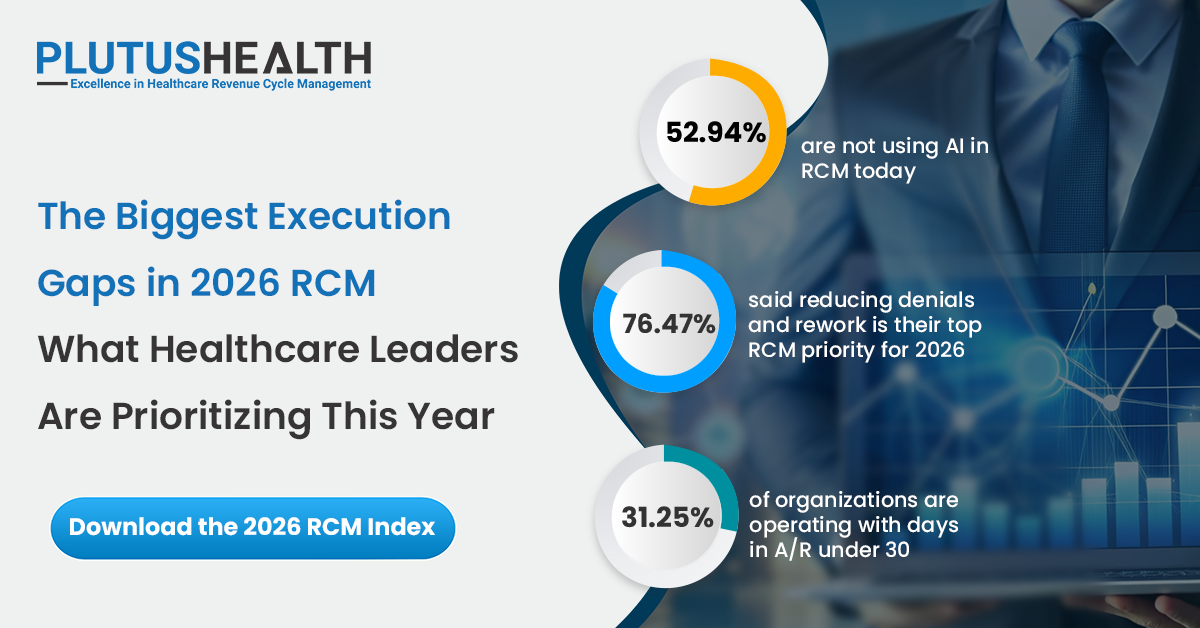
AI and automation are widely viewed as critical to the future of RCM, yet adoption remains early and fragmented. Where AI is currently used, it is largely limited to front-end functions such as eligibility verification and claim scrubbing. High-effort downstream workflows, including AR management and patient billing, remain largely manual across most organizations.
The Index positions Plutus Health as a clear reference point for what execution at scale looks like. Through Olympus AI, our AI-driven workflow and workforce orchestration platform, Plutus Health consistently delivers outcomes that many organizations are still pursuing, including denial rates under 5%, days in A/R below 30, and net collection rates above 98%.
These results reflect a fundamentally different operating model that combines automation, analytics, and human expertise within a single system.
Healthcare Organizations are encouraged to familiarize themselves with the report and use its insights in conversations with clients, prospects, and partners as we continue positioning Plutus Health as the execution partner for healthcare revenue operations in 2026 and beyond.
Plutus Health has officially released the 2026 RCM Index, a comprehensive industry benchmark report based on a nationwide survey of healthcare revenue and finance leaders. The Index captures how organizations are actually managing revenue cycle operations as they prepare for 2026, highlighting both progress and persistent execution gaps across the industry.
The findings reinforce a reality many teams experience daily. While healthcare leaders broadly agree on what needs to change in RCM, performance remains inconsistent.
The data makes one thing clear. The challenge for 2026 is no longer awareness. It is execution.
The 2026 RCM Index highlights a shift in operating models across the industry. Hybrid RCM has become the dominant approach, with organizations maintaining core control in-house while selectively engaging partners for automation and specialized expertise. Fully outsourced models remain limited, indicating a preference for flexibility, ownership, and control over execution.
AI and automation are widely viewed as critical to the future of RCM, yet adoption remains early and fragmented. Where AI is currently used, it is largely limited to front-end functions such as eligibility verification and claim scrubbing. High-effort downstream workflows, including AR management and patient billing, remain largely manual across most organizations.
The Index positions Plutus Health as a clear reference point for what execution at scale looks like. Through Olympus AI, our AI-driven workflow and workforce orchestration platform, Plutus Health consistently delivers outcomes that many organizations are still pursuing, including denial rates under 5%, days in A/R below 30, and net collection rates above 98%.
These results reflect a fundamentally different operating model that combines automation, analytics, and human expertise within a single system.
Healthcare Organizations are encouraged to familiarize themselves with the report and use its insights in conversations with clients, prospects, and partners as we continue positioning Plutus Health as the execution partner for healthcare revenue operations in 2026 and beyond.

Dallas, TX – [November 21, 2025] – For the third year in a row, Plutus Health has been named to the SMU Cox Dallas 100™ Entrepreneur Awards, joining an extraordinary group of companies driving innovation, job creation, and growth across North Texas.
Founded in 2008, Plutus Health has grown into a global RCM partner with over 1,600 specialists, transforming revenue cycle management through Agentic AI, robotic process automation, and Lean Six Sigma practices. By pairing technology with human expertise, the company helps providers minimize denials, accelerate reimbursements, and strengthen their financial health so they can focus on patient care.
What makes this year special? Plutus Health’s growth reflects not only its own success but also the trust of clients nationwide and the strength of the Dallas business community. Back-to-back recognition reinforces that Plutus Health is not just keeping pace with change but pushing the boundaries of what’s possible in healthcare RCM.